1.
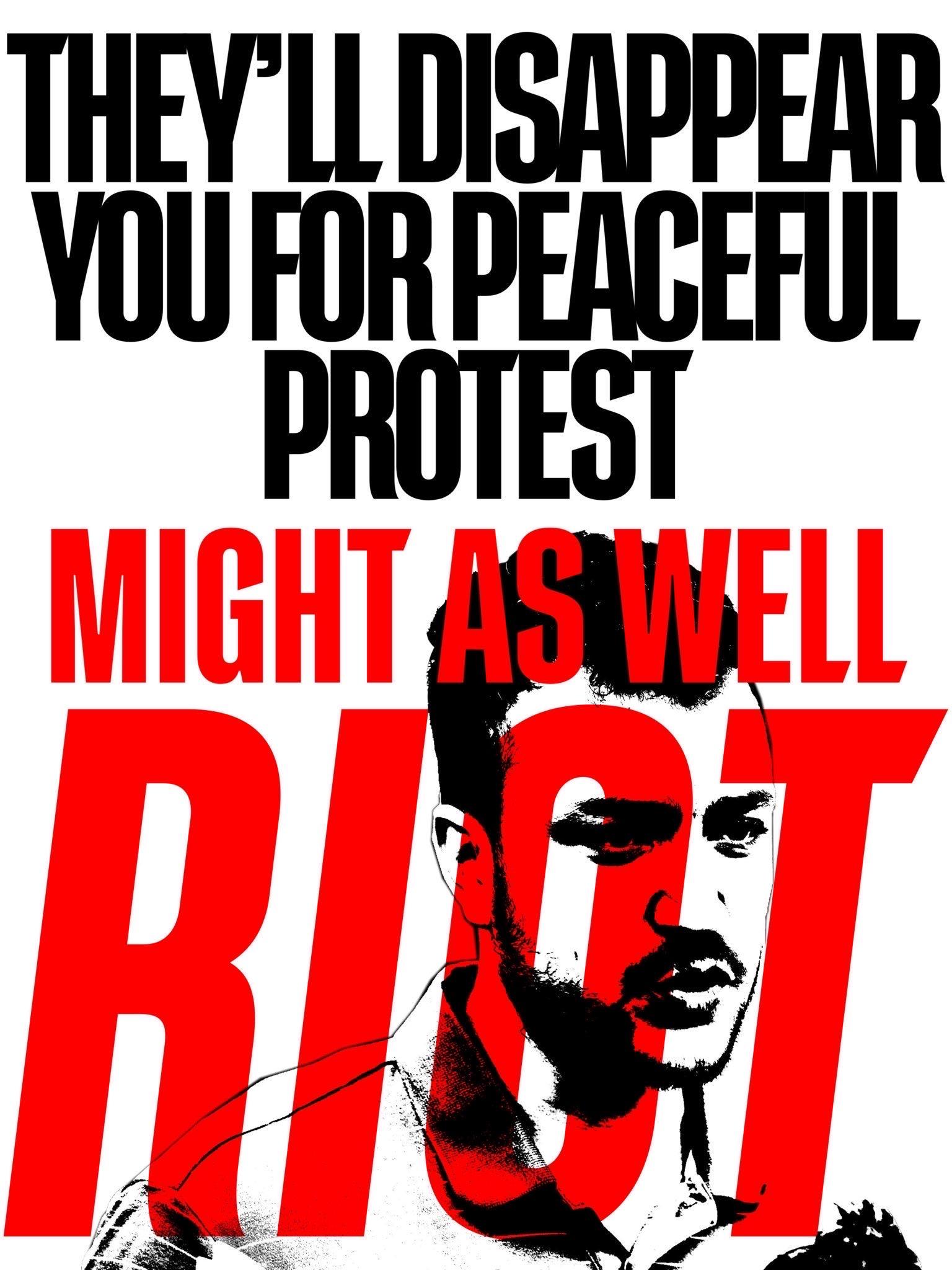
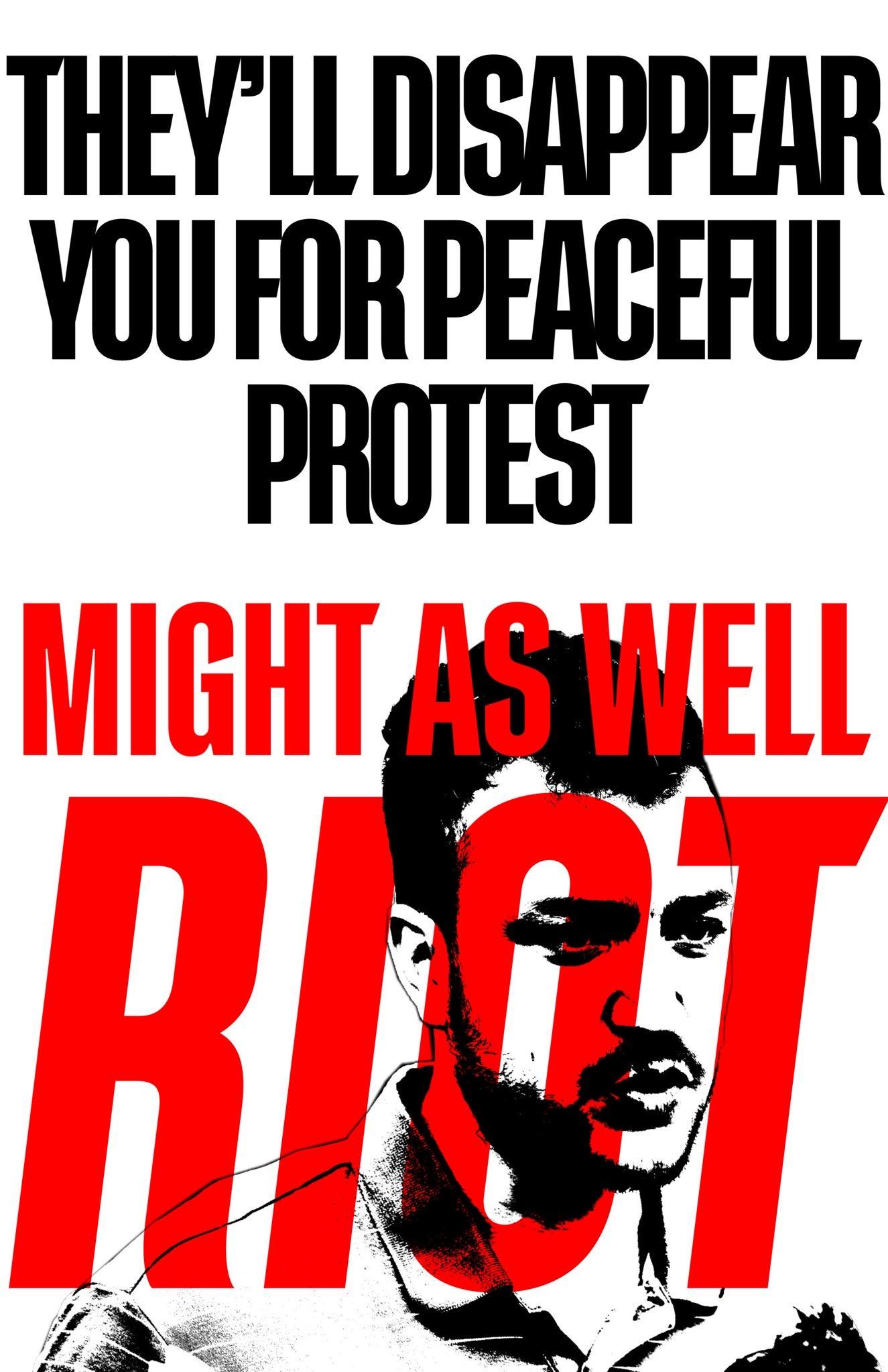
The movement against ICE in Minneapolis-Saint Paul (MSP) is a deeply insurgent mass movement. It is incredible and beautiful. You have probably seen dozens of videos on your phone of clashes between the ‘invading’ Federal forces and brave Minnesotans. The Feds seem furtive, swine-like, waving around military weaponry. Their adversaries, mostly armed with nothing but signs and whistles, routinely demonstrate immense physical courage, and routinely succeed in disrupting ICE’s operations.
These videos are just fragmentary evidence of the generalized intelligence, coordination, and righteous clarity of the movement. Thousands of people every day are involved in highly organized rapid response networks, scouting and tailing ICE vehicles. Maybe just as many are taking on the invisible work of reproductive care for migrant neighbors: driving people to work, and delivering groceries to their homes. We assume that the networks of rapid response and reproductive care run deep within immigrant communities in ways that are not visible to even the most sympathetic white participants in the movement. No one person can directly experience the entire scope of this activity.
Nor has the movement let up: for weeks, people have maintained pressure on everything that the Feds do. Three shootings, including the highly visible and disturbing murders of Renee Good and Alex Pretti, have not cowed the people back into their homes. They are regularly innovating new tactics that demonstrate a clear understanding of the enemy’s vulnerabilities. To even come close to meeting its quotas ICE must drive cars, which can be identified by plate or slowed by blockades; they must flee almost as soon as they abduct someone or else they will be surrounded; they have to stop for gas, coffee, and meals, all of which are sold by people who have every reason to despise them; and they must return at night to their hotels, where their sleep can be disturbed, and so on. The movement’s strength lies in its strategic unity: find out where ICE is, and make it impossible for them to continue doing their job.
We believe that everyone of conscience and ability should go to MSP and participate in the movement in order to learn from it and contribute to it.
2.
In “Chipocalypse Now,” our collective’s year-in-review of the anti-ICE struggle in Chicago, we concluded that tech-based rapid response networks and patrols were a “red herring” here, because they never succeeded in creating a tangible problem for ICE’s operation. Obviously, the situation in MSP is different. We believe that the mass movement in MSP is in very large part the result of the profound over-saturation of Feds in a relatively small geographical area. It is likely that the “average” MSP resident will see or hear Feds in their neighborhood or near their workplace on any given day. This was never even remotely true in Chicago, not even at the height of “Operation Midway Blitz.” The high saturation of Feds in a smaller area means that a dense tech and car-based patrol and rapid response network is much more effective than it could have been in Chicago. There are, of course, many other specific conditions in Chicago that we have pointed to in order to explain the marginality of the anti-ICE movement here.
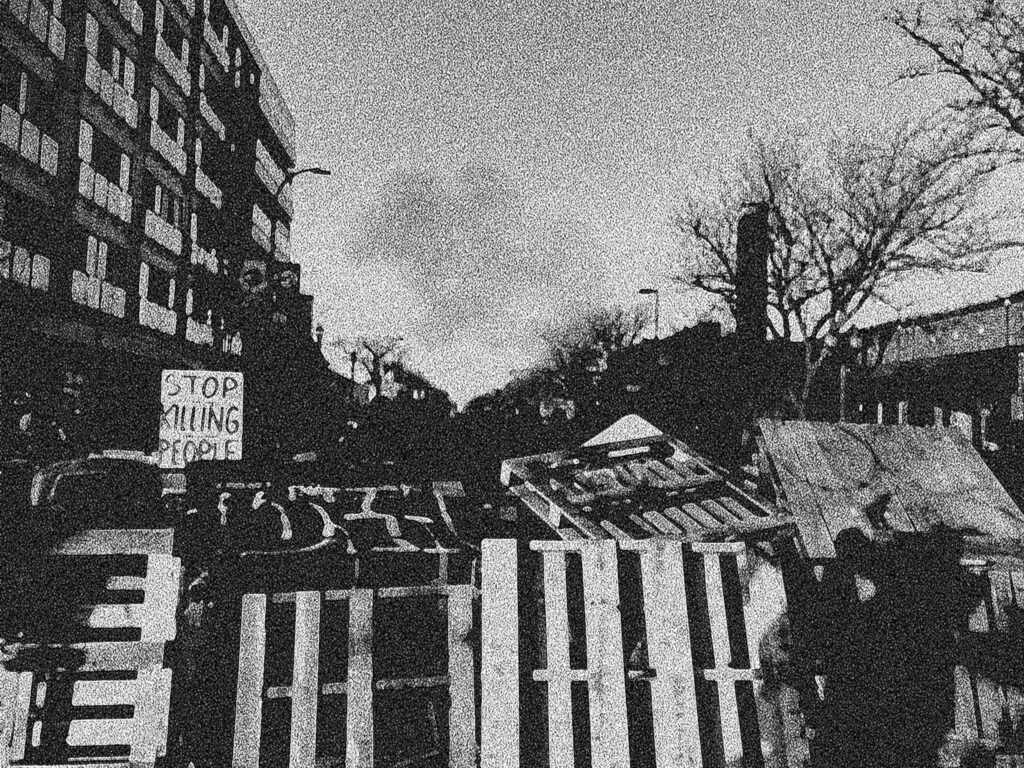
Hours after the shooting of Alex Pretti, several square blocks around the site of his murder were barricaded and occupied by many hundreds of vigil-keepers and angry protestors. This zone was soon inundated with coffee and food to be shared, blessed hand and toe warmers, and other evidence of the robust mutual aid and charity networks in MSP that support the movement. Eventually the crowd dissipated and the zone was retaken by the city. In the absence of ICE agents themselves, the crowd had nowhere to go but home. The movement had no other commonly legible targets, nowhere to march, nothing in mind to expropriate.
If we were to make a list of the cruel social technologies that make ordinary life into an endless trial for recent illegal immigrants and asylum seekers, even in so-called sanctuary cities, we would never get to the end of it. But we could start with hyper-exploitative, under-the-table employment situations, city police, local incarceration infrastructure, surveillance infrastructure, and precarious rentals with evil landlords: none of these things is a direct target of the MSP anti-ICE struggle.
3.
We think that rather than arguing against this fact we should first try to explain it. The movement against ICE in MSP has a distinct racial and class composition. The considerable numbers of people who, on a daily basis, are finding time in between work and sleep, or taking off work, to bravely interfere with ICE are by and large white, liberal, and middle class. This is not an insult. Their means are inventive, courageous, and often illegal, their motive and their object rational. They are acting in defense of their neighbors, racialized immigrants who might also mow their lawns, mind their children, or serve their food. At the same time they are acting in defense of putatively universal principles that, for people of their own class and race, are made actual by the US Constitution.
These same motives have not activated black and brown proletarians en masse: not in Chicago, and not in the Twin Cities. If this were to happen, then we assume that ICE, currently demoralized and on the defensive, would not stand a chance. But it has not happened. Among Latinos in Chicago, of which there are many subgroups fractured along lines of nationality and citizenship, the voice of “reason” argues for respectable calm; it insists that people carry their papers with them at all times and cooperate. As is usual in the United States, immigrants of even slightly longer standing are quick to align themselves against more recent immigrants who they have learned to regard as competing with them for the benefits of American imperialism. Perhaps as many as a third of ICE agents are Latino. (If anyone still finds this situation comic, or confusing, we would suggest reading Noel Ignatiev’s How the Irish Became White or Fredy Perlman’s “The Continuing Appeal of Nationalism”). And, despite the South Shore apartment raid in Chicago and the more recent targeting of Somali immigrants in Minnesota and Maine, the common sense is that this struggle has little to do with black people—who, let’s not forget, undertook an incredibly arduous decades long struggle to gain civil rights in this country only to have all of them effectively revoked.
4.
Thinking through these things one month ago, we asked ourselves: how can the struggle against ICE now emerging in force in MSP be turned into a revolutionary struggle? Our assumption—our hope, anyway—was that popular opposition to ICE’s enforcement of immigration policy implied nascent opposition to the border as such. Maybe the people bravely opposing ICE could be shown that what they were really already fighting against was the segmentation of the entire world into captive labor markets separated by machine guns and barbed wire, delineating populations of the elect and the “damned of the earth.” We wondered if, as pro-revolutionaries, we ought to be doing something to or in the movement, that would reveal its true character and raise the temperature of its ambitions even further. Maybe what was needed was the introduction of an apt gesture or a more incisive slogan that would clarify and redirect the energy of the people already in the streets.
Having investigated the actual composition and politics of the MSP anti-ICE struggle, and reflected on how it is like and unlike Chicago, we now understand that this was not the right set of questions to be asking. What we have learned is that this struggle requires no clarification by us. Its political disposition (against ICE as, specifically, a foreign ‘invader’ representative of the Trump administration, which is trampling basic constitutional protections underfoot) is perfectly consistent, and it is perfectly matched with the interests of the supermajority of its participants. The movement’s horizon has already been described by none other than Governor Pritzker, whose response to the murder of Alex Pretti was to call for the abolition of “Trump’s ICE.”
We think it is impossible to turn the ICE struggle we find already underway into a revolutionary struggle. Moreover, we think the experience of humiliating defeat for the Feds is unlikely to be repeated in the same way in any other city. Without the complete saturation of a city by federal agents, there is no reason to suspect that the demographic activated in the Twin Cities would be motivated to act with anything like the same degree of determination and coordination in other places. We believe that our conclusions about the potential of tech-based rapid response and patrols in Chicago will remain true here, even in the event of a renewed ICE surge in the Spring. We also believe that this will remain true in the cities that are now trying to “capture” the upsurge of anti-ICE energy generated by the situation in Minnesota. We do not want the energy of the moment to be squandered in maintenance of endless Signal threads or logistical busywork in preparation for something that likely will not come to pass. We do not wish for increased ICE activity anywhere, but, obviously, we hope that ICE will be met with defiance and inventive mass illegality everywhere they go.
5.
To think and act clearly, we must begin from the fact that the anti-ICE struggle in its current form has a stake in the continued exploitation of regulated illegal immigration. It does not command or deserve universal participation. We do not want to spend the next three years reading about how the anti-ICE movement failed because it was “co-opted” by liberals. This is a sore loser’s fantasy. It springs from the arrogant and wrong idea that every mass movement’s infrastructure is “ours” for the taking and that everyone already believes, in their heart of hearts, what we believe. Our job as revolutionaries is to convince people of our ideas, which they broadly have never even considered, and participate in situations in which our ideas can prove their usefulness.
Where there is bravery and insurgent energy—and we believe there will only be more in the months and years to come—there must be a visible and appealing alternative to the status-quo demand for “ICE out” and the return of legal and economic normality. There must be real, in-person places of encounter between the already politicized, the large numbers of the déclassé who will soon become politicized, and the even larger numbers of racialized proletarians in the United States, those who suffer the most from the legal-technological apparatus that sustains the border and the economy, and those who suffer the most at the hands of regular police. We think that illegal immigration is a stunning, courageous achievement that shows us something of what full-fledged humanity would be. If we want to become human—and if we want a shot at collectively surviving the next hundred years of ecological and economic crisis—we should aspire to concrete brotherhood and sisterhood with illegal immigrants. Thus far, with some exceptions, immigrants have been wards of the charitable movement, barred by circumstance from meaningful participation.
We have thus far been unable to form a recognizable pole that clearly communicates the stakes of the struggle as we see it. If this pole were to form, it would not automatically win the support of the majority of people who are already involved. But it would compel them to choose sides, either with the vestiges of the liberal political class, or with the millions of people yet to be activated. The events in MSP prove that the state has no good answer to mass activity, mass illegality, even when it is undertaken by a relatively small layer of the middle class. The conjuncture we are in at this moment is favorable to us because the ruling class and some of its traditional junior partners are disunified. We cannot afford to be confused about where we stand and who is on our side.
K. & T.